Keeping the Books Abroad — How To Finance a Year Long Round the World Trip
Money is a dirty word. We really hate talking about it in the US. It’s so personal and completely uncouth. Because of that this post may be distasteful, intriguing, TMI, or even feel like bragging to you. My point in writing it is that we’re asked this question often and I know it was one of those things people tiptoed around in the US before we left. People say, “Wait, you don’t have a job and yet you’re traveling… for nearly a whole year?!” Yep, I agree, that’s kind of absurd. I didn’t think it was possible either, but I’d like to walk you through how we’re doing it.
First off, we’re not crazy rich or trust fund babies. Most of you know this, but it’s worth saying that, while we come from middle and upper middle class households, we were working professionals making our own way up until we left. We lived in a modest apartment in Baltimore City, together paying $850 for rent monthly, along with utility costs that added another $100 or so to the base cost of living. Add in other bills, and the general cost of having a young professional’s lifestyle, like drinking out, going for coffee, or eating a decent restaurants, we were spending quite a bit of money each month just existing (in a volume that’s greater than I care to think about). Neither Jason nor I are much into “things”. We aren’t much for buying stuff at least and prefer foods and experiences over the appeal of a new gadget. Because of this, and limited carrying capacity, we have a serious lack of souvenirs.

Despite not being trustafarians, we did have well paying jobs that allowed us to save up during our planning process. Salary talk is again considered ill, but we made good money and held middle management positions in our companies. Being childless is also key here, because if we had a kiddo we’d have surely invested our cash into that little life.
A few months after Jason and I met he told me it was his dream to travel the world. It was not my dream. My dreams had been fairly well taken care of. When I was 27, I took my gap year to farm, then came back to work for a company that I thought was doing well for the world in a position that I enjoyed (almost) every day. My family and friends were close by. I lived in a city that I was invested in from a personal and professional standpoint. Plus, I had a habit of travelling a few times each year anyway, more than the average American does. I enjoy exploring various parts of America. Jason, on the other hand, needed to go beyond the sea to shining sea and see what life was like somewhere else. I didn’t even have a valid passport when we met. I wanted a dog.

During the course of our relationship my dad got sick and eventually passed away. He left us in June of 2015. He was my top priority when he was alive. After we lost him I could start to entertain the idea of long term travel. We began discussing the idea more in depth. We had several emotional talks over our priorities as a couple and what the future held. I eventually said, “Yes” to a dream that I still felt was his, but was beginning to become mine. We started saving and planning.
In 2016, we really hit the ground running with our plans. Discussions surrounded routes, timelines, overall goals, health and insurance, backup plans, keep in touch with the people at home, equipment, and most important to the trip’s success: budget. We decided we’d like to spend $30,000 in total between us, all in. That figure meant we’d not drain our savings, nor will we have to put anything on the credit card, and we should still be able to see and do a decent chunk of what we wanted.
We knew from the get-go this was a budget travel trip, not luxury. No resorts, no crazy sightseeing tours, no overpriced excursions, no scuba certifications; nothing that would break the bank. This means we’re missing out on activities a casual, short term traveller would partake in where spending isn’t a concern, but if we didn’t skip some of that we would never be able to adhere to our budget. We also originally thought we’d only be gone nine months, but due to the crazy Affordable Care Act exemption requirements we had to extend to 11 to ensure we don’t get fined over $1,000 each for not having insurance for the past year. We did not increase our budget. Make that 30K stretch!
It’s worth noting that prior to the trip, even though Jason and I lived together, we did not share finances. I’ve never shared my finances with a partner and rather liked it that way! I very fortunately had made enough that I didn’t have to. In the beginning, our lack of prior experience together in this area meant there was some fierce bickering about how money should be spent. I have a YOLO streak and that makes me more of a spender. Jason is far more frugal and can go without in ways that can feel torturous to me, but natural to him. He’d eat instant ramen from 7-11 every day if he was travelling solo. I’d drink expensive craft beer every time I got my hands on it. We’ve become better at compromise, now three months in, but it wasn’t easy at first.
We still don’t have a shared bank account, but we track our costs through an app that Jason has built specifically for our trip. Building the app helps keep his mind busy programming while providing a useful tool. It doesn’t just track expenses, it tracks the places we’ve been, our accommodations, the sights we’ve seen, and a map of it all, along with pictures and a beautiful interface. It tells you where we are today and where we’re going next. I’ll show you all one day, when it’s ready! 🙂
We planned on the trip having three distinct spending parts: expensive Asia, cheap Southeast Asia, and mostly expensive Europe. We were going to breeze through expensive Asia for the first five weeks, then spend five months or or in Southeast Asia, then finish the trip in Europe where some places would be insanely expensive and others more moderately priced. With this plan we’d never need to wear a winter coat and that means we’ll hardly ever check a bag (saving more $$). We did not plan to go to Australia, but after finding a great flight deal and a volunteer working opportunity that covers room and board we felt like it would be foolish not to go.

Summer of 2016 we made our first real trip purchase, tickets to Korea. We found a great deal on China Southern Airlines for $400 per person for the one way journey. It was 1/2 what we thought we would spend, so we felt it would be really foolish to turn it down. From there, we booked more flights and accommodations until the first six weeks were set up. By the end of July, we had all of expensive Asia booked and paid for, minus attractions and food. Pre-trip spending was around $4,000. Just because we spent it before the trip, while we had jobs, didn’t mean that we could increase our budget any, it just meant that we could pay for the trip with an inflow of cash versus strictly our savings.
New Year’s Day puts us at exactly 1/3rd of the way through our trip. Because of the way that our budget works we should actually have spent less than 1/3rd of our budget by this point. This is due to our plan to be in “cheap” Southeast Asia for another few months. Unfortunately, we are more than 1/3rd of the way through our budget. How did this happen? Basically, we didn’t think attractions and food would cost as much as they have; our mistake. We were fairly spot on with our accommodation estimates. Flights are a little more expensive than we bargained for, but not by an exorbitant amount. It’s just the day to day living that’s driving our costs higher than expected. Now, since we’re headed to very expensive Australia next, we have to be extra vigilant on our spending.

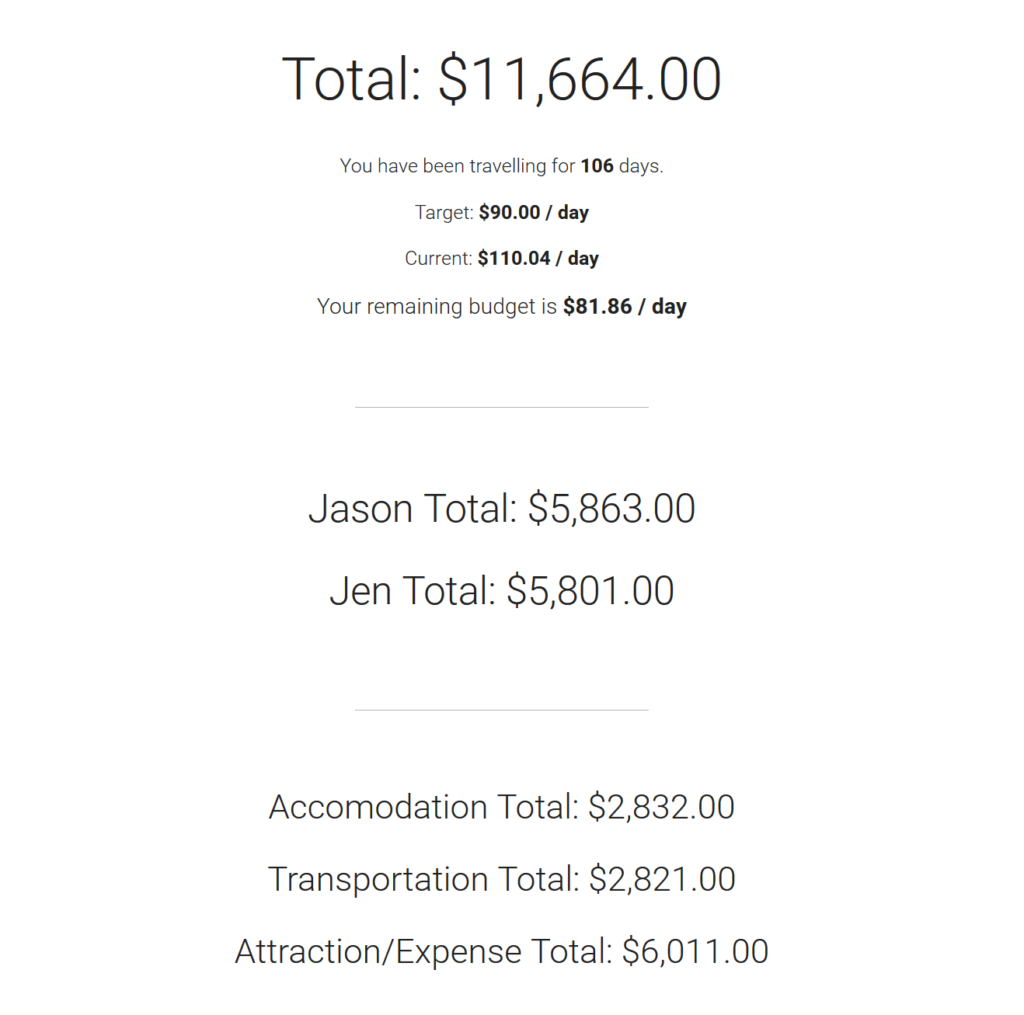
Below, you can see how we’ve arranged the budget. This is collective, not separate, so together we want to keep the spending at $90 per day throughout the entire trip, averaged out. Clearly, in very expensive cities like Tokyo, Singapore, and Rome, we’re going to go way over that so we need to compensate by going far below in the cheaper places. Right now in Kuching, we’re spending about $40 per day all in and we’re staying here for one month. Everyday here, before we do, eat, or drink anything, we are paying $20.50 for our hostel (at $16.50 per night) and the transportation to fly here ($4 per day on average). Today we had one meal out that cost $7 for the both of us. So, that means our total today was 27.50. Many days we spend more than that. Every ringgit/dollar counts. But, it’s cheap in Kuching! We love that, and that’s why we planned to stay here for so long. However, since we’re not just spending whatever we want whenever we want we are going to miss a few special attractions. C’est la vie.
Something to note is we’ve received some very generous monetary gifts from friends and family. We are extremely grateful for their goodwill, but we’re trying not to have that alter our 30K mark. As Jason has reminded me time and again, it’s nice to have extra money, but it shouldn’t affect how we spend day to day. Yes, sometimes we can do something extra special and attribute it to a gift, but we can’t just increase the budget. Again, I’m a spender, he’s a saver, so he’s being reasonable and I’m desiring excesses.
Once we make it to Europe we plan to visit several of the must see spots, but we also plan to work on farms or do other kinds of volunteering to both become part of the community in a that way a tourist can’t and to save money. Trading labor for housing and food is something I’ve done before and adore. I wish more of the world was set up like this. Europe has a greater number of opportunities for this than in the US, so if you’re thinking about long term travel I encourage you to consider this as a way to save money and really meet local people.
I’m not exactly sure what will happen in the next few months money wise. My mom asked me if we go over budget do we go home early? Probably not. We’d have to go pretty significantly over budget to do that. That said, when we get back our goal of buying a house and settling down is more important than this trip, so if that reality feels compromised we’ll definitely consider it. We talk about our spending on a daily basis, so this isn’t something we’re ignoring or doing without much though; it’s a balancing act.
Next off topic-topic is packing! That post won’t nearly be as long, but it’ll certainly have more pictures! Thanks for tuning in. Until next time. Happy New Year!